



Organic Hair Oil: How to Choose the Right One for Your Hair
|
Don't leave yet. We have a special offer for you!
|

Long before hair growth serum, minoxidil, or PRP therapies became mainstream, oiling was the foundation of great hair. Oiling was a daily ritual in most Indian homes- for hair, as moisturizer, and for massages. In Ayurveda, oiling was never treated as a hair-only habit. It was part of a full-body reset: joints, skin, scalp, all treated with the same warm-oil ritual, because Ayurveda has always believed that the outside of the body deserves the same care as the inside.
Organic hair oil was a staple and the most widely used therapy, not because it was fighting hair loss, but simply to maintain scalp and hair health. Somewhere between then and now, oiling is reduced to once a week, before hair wash day. But if you actually understand why Ayurveda built oiling into daily life, and why trichology agrees with that logic today, you start choosing oil very differently.
In Ayurvedic thinking, hair health is a downstream effect of how balanced your body is: your doshas (Vata, Pitta, Kapha), digestion, gut health, stress levels, and sleep quality. Oiling isn't just a spot treatment for hair; it's a therapy that calms the nervous system through touch, improves circulation, and nourishes tissue from the outside in.
Read more about the Ayurvedic Philosophy of Hair Loss.
That's why Ayurvedic oiling rituals traditionally extended to the scalp, temples, ears, and even the soles of the feet because the body was seen as one connected system, not a collection of separate problems.
For that reason, oil is considered a ritual, not a one-time thing. Oiling works best when it's unhurried. A rushed, five-minute oil-and-rinse doesn't give the scalp time to actually absorb anything. A slow, warm oil massage does two things at once: it delivers nutrients, improves scalp circulation, and lowers cortisol. And cortisol, as it turns out, is one of the more underrated players in hair thinning.
What Ayurveda has been doing for centuries is now proven by modern trichology and science. Healthy hair growth starts at the follicle, and the follicle lives in the scalp and is nourished through our body, not the hair shaft. So anything that improves scalp circulation, reduces inflammation, and keeps the skin barrier balanced is directly supporting the environment your hair grows in.
Oiling, when practiced correctly, checks several of those boxes.
Scalp Circulation: Massage increases blood flow to hair follicles, which helps deliver oxygen and nutrients to the root.
Barrier support: A well-chosen oil helps lock in moisture and protect the scalp's natural lipid layer, which is often disrupted by harsh shampoos, hard water, or over-washing.
Inflammation control: Many organic hair oils have natural anti-inflammatory compounds that calm an irritated or flaky scalp, a common, overlooked contributor to hair fall.
In other words, oiling isn't a “nice to have” add-on to your hair routine. It's the foundation for hair growth. If your scalp is inflamed, dehydrated, or clogged, no serum or supplement will perform at its best.
Just like our skin, scalps have types, and Ayurveda actually mapped this centuries before dermatology did, though it used doshic language instead of clinical terms.
Oily Scalp or Kapha-dominant scalp:
Prone to buildup, sluggish follicles, and slower-feeling growth, an oily scalp needs lighter oils that won't add to congestion. Think jojoba, or a light neem-based blend, used sparingly and washed out well.
Dry Scalp or Vata-dominant scalp:
Flaky, tight, prone to frizz and breakage. Dry scalp benefits from richer, deeply moisturizing oils like sesame, almond, or castor, left on longer to truly penetrate.
Sensitive scalp or Pitta-dominant scalp:
Prone to redness, itchiness, or heat-related irritation, and often hair thinning in a sensitive scalp is tied to stress or inflammation. It's best to use cooling, soothing oils like coconut and bhringaraj.
Normal scalp or combination scalp:
Can tolerate a broader range but still benefits from a balanced, multi-oil formula rather than a single heavy oil.
Once you know your scalp type, choosing an oil stops being guesswork.
Not every person suffers from the same type of hair loss. Your hormones, nutrition, lifestyle, stress, and the environment play a role and affect your scalp. Each of these factors puts a different kind of stress on the follicle, so the right oil isn't just about "growth" as a generic goal; it's about identifying what's actually happening at the root and choosing bio-actives that correct that specific imbalance.
Dryness-Driven Hair Fall:
When the scalp is dehydrated and lacks moisture, the skin barrier weakens, hair becomes brittle at the root, and strands shed more easily during normal handling. Richer base oils like sesame and almond, layered with argan or castor oil, restore moisture and reduce the breakage that gets mistaken for hair loss.
Inflammation and Irritation-driven Hair Fall:
A scalp that's frequently red, itchy, or reactive is under low-grade inflammatory stress. Inflamed follicles struggle to hold hair in their growth phase. Cooling, calming ingredients like bhringaraj and neem help settle that irritation and give the follicle a steadier environment to function in.
Buildup and Congestion-driven Hair Fall:
An oily, congested scalp can smother follicles under product residue, sebum, and dead skin, weakening the anchor a hair strand needs. Lighter actives like rosemary help clear this buildup without over-stripping natural oils, so follicles aren't working against blocked pores.
Sometimes hair fall isn't about damage at all. It's about follicles that simply aren't in a strong growth phase. Ayurvedic ingredients like Amla, hibiscus, and bhringaraj are traditionally used to strengthen the root and support the scalp's natural collagen-like structure, encouraging existing follicles to hold hair longer.
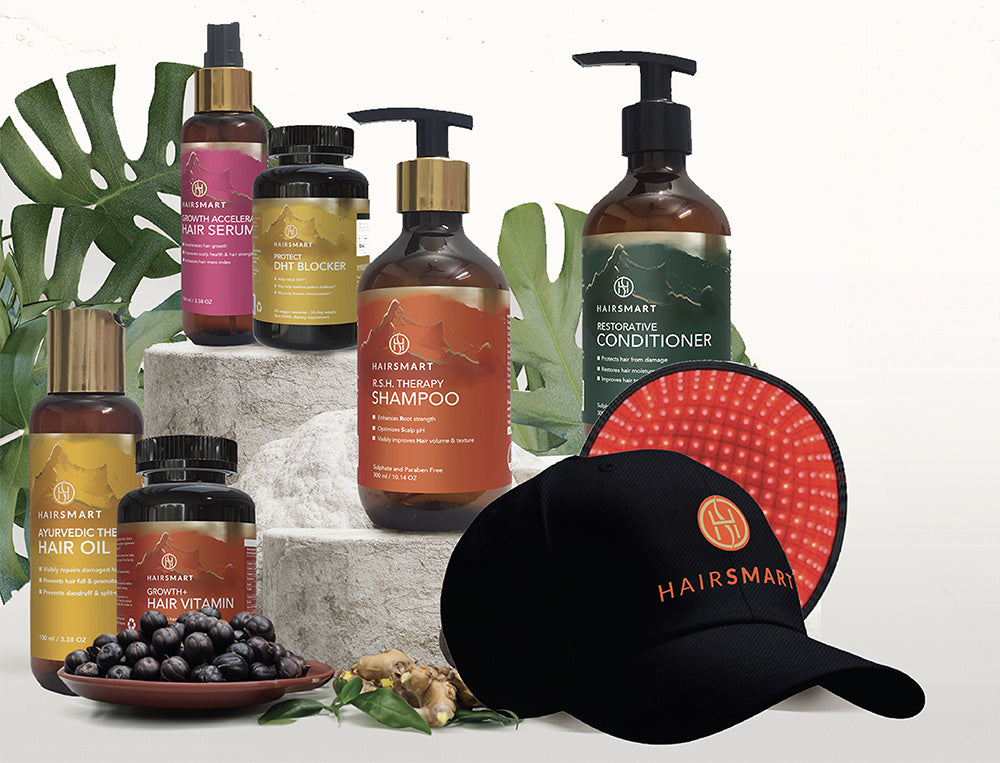
Most all-natural hair oils on the market are either purely traditional- heavy, single-note, and slow to show results or purely cosmetic- light, pleasant-smelling, but not built to actually support the scalp. This is the exact gap HairSmart Ayurvedic Therapy Oil bridges.
The best essential oil for hair growth is rarely a single-ingredient bottle. So instead of picking one active and hoping it fits every scalp, we combined the best Ayurvedic hair care botanicals into one oil. Our therapy oil combines nourishing base oils with actives like bhringaraj, amla, neem, tulsi, and rosemary, chosen specifically because they work across scalp types rather than serving just one. It's formulated to be gentle enough for a sensitive or reactive scalp, light enough for an oily scalp, and nourishing enough for a dry one. The aim is not to let you choose between safe and effective.
HairSmart organic oil for hair is 100% organic, free of sulfates, parabens, and synthetic fragrance, and designed to be used as part of a real ritual, not a rushed step before shampoo.
Choosing the right organic or herbal hair oil isn't about finding a miracle bottle. It's about matching the oil to your scalp's actual needs, giving it time to do its job, and treating the ritual itself- the massage, the warmth, the pause- as part of the benefit, not just the delivery mechanism.
That's the piece Ayurveda understood a long time ago, and it's the piece trichology is now explaining in clinical terms: healthy hair starts with a healthy scalp, and a healthy scalp starts with consistent, intentional care.
Oiling your hair two to three times a week is a good starting point for most scalp types, left on overnight or at least an hour before washing out.
Organic and herbal oils won't work overnight. But gradually, they help improve scalp circulation and reduce inflammation to create a healthier environment for existing follicles to function well.
Most single-ingredient oils aren't suitable to be used for all scalp types. But a well-formulated blend like HairSmart Ayurvedic Therapy oil, made by combining lighter and richer base oils with targeted actives, works across oily, dry, and sensitive scalps.
Hair oil should ideally be applied to dry hair and scalp, ideally before washing. Applying oil to wet hair dilutes it and reduces absorption.
Most people notice a difference in scalp comfort and hair texture within 4–6 weeks of consistent oiling, but visible changes in shedding and regrowth need more than just hair oil- a complete hair regrowth system. Since hair growth cycles move slowly by nature, natural hair regrowth with the HairSmart system takes approximately 4- 6 months.


